


The digital commerce landscape is at a turning point. With U.S. online sales surpassing $300 billion in Q2 2025 and nearly five million Shopify stores competing, entry barriers have vanished. Yet only 10–15% of brands sustain real success. In this era of saturation, strong products are not enough. Winning brands differentiate through strategic infrastructure, technology integration, and behavioral insight. This analysis reveals key lessons for dominating e-commerce in 2026.
Engineering Predictable Revenue
In an era defined by market volatility and fast-changing consumer behavior, stability has become the foundation of sustainable e-commerce growth. Brands seeking long-term success must move beyond temporary growth hacks and adopt structured strategies that enable predictable scaling. A strong presence on platforms like Shopify represents more than a sales channel it reflects a commitment to operational efficiency and customer trust. Reliable platform ecosystems reduce risks tied to migrations, backend failures, downtime, and performance slowdowns. This stability becomes especially critical during high-traffic moments such as Black Friday, Cyber Monday or viral product launches, where infrastructure weaknesses are quickly exposed.
As brands scale, operational fluency shifts from advantage to necessity. Transitioning from mid-market growth to high-volume enterprise requires disciplined technical management, including minimizing technical debt, preventing plugin overload, and safeguarding data integrity during migrations. Managed infrastructures such as Shopify Plus help absorb traffic spikes through a distributed cloud architecture, ensuring consistent performance and user experience. By treating development as a strategic business function rather than a technical afterthought, organizations align every technical decision with measurable impact strengthening operations, improving customer support, and enhancing marketing effectiveness.
The Content-Authority Nexus: Forging Trust Through Narrative
Brand authority begins with a deliberate content strategy. For Shopify merchants, a blog is not just a publishing space but a strategic asset that builds trust, improves SEO, and drives conversions. By consistently delivering helpful, educational content, brands position themselves as credible leaders within their niche. Instead of relying on intrusive advertising, they earn attention by solving real customer problems and guiding informed purchase decisions. This trust becomes especially powerful for high-consideration products, where confidence directly influences conversion.
Effective execution requires structure. A balanced approach often framed as a 30-30-30 mix of original content, curated insights, and promotional messaging keeps engagement high without appearing overly sales-focused. Maintaining a disciplined content calendar ensures consistency, builds momentum, and prevents the visibility drops that come with irregular publishing. Over time, this steady output compounds into stronger brand recognition and improved search performance.
In B2B markets, content must support longer and more complex buying cycles. Decision-makers expect clear ROI justification and in-depth information tailored to multiple stakeholders. Defining an Ideal Customer Profile and aligning content to each stage of the buyer journey strengthens lead quality and shortens sales cycles. High-quality, search-optimized content ultimately becomes a predictable acquisition engine, reducing dependence on rising paid advertising costs while protecting long-term margins.
Mastering Financial Engineering
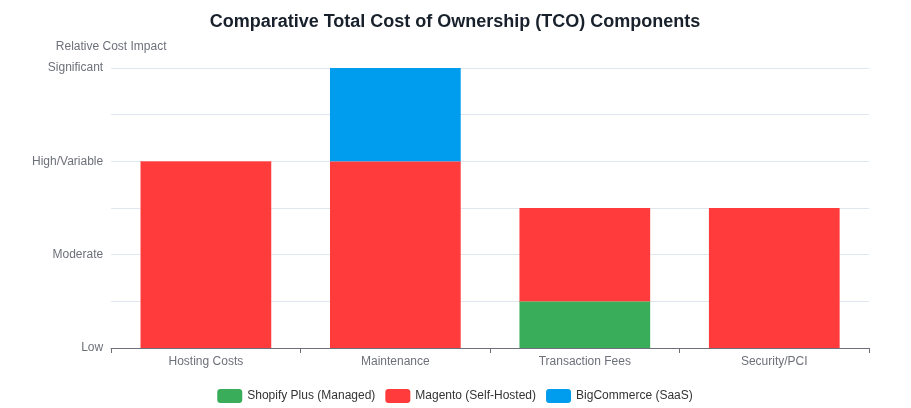
An e-commerce platform’s long-term success depends heavily on its Total Cost of Ownership (TCO), which includes licensing, hosting, development, maintenance, and transaction expenses over time. For high-volume merchants, Shopify Plus often delivers stronger financial efficiency compared to enterprise alternatives like Magento or BigCommerce.
Research shows Shopify’s TCO is roughly 33–35% lower than competitors, largely due to its integrated SaaS model. Unlike self-hosted platforms that require premium infrastructure, constant upgrades, and dedicated maintenance teams, Shopify consolidates these costs into a more predictable and streamlined structure.
Unified commerce on Shopify delivers measurable financial benefits. Brands using integrated solutions like Shopify POS report 22% lower TCO and 20% faster implementation compared to complex multi-vendor stacks. Eliminating middleware, connector fees, and siloed data management can save large enterprises hundreds of thousands annually. Daniel Wellington, for example, reportedly saves over €500,000 per year after migrating.
Automation tools such as Shopify Flow further reduce operational workload, saving the equivalent of nearly half a full-time employee per store and freeing capital for growth initiatives.
Strategic Architecture: Headless Commerce as a Future-Proofing Imperative
As enterprises expand in scale and complexity, traditional monolithic commerce platforms often limit agility and innovation. To overcome these constraints, many high-volume brands are adopting headless commerce, an architecture that separates the front end from the back-end engine. This model enables developers to create customized user experiences with modern frameworks while maintaining stable core operations through APIs.
Driven by demands for speed, flexibility, and seamless integration, headless commerce is becoming the enterprise standard. Edge hosting, modular services, and centralized CMS solutions improve performance, scalability, and cross-channel consistency while supporting continuous innovation. This evolution mirrors broader shifts explored in our analysis of the Future of Web Development Trends for 2026, where AI-first engineering, compiler-driven optimization, and intelligent digital ecosystems redefine how high-performance web experiences are built. Successful adoption typically includes:
- Phased migration planning to prevent downtime
- Careful data migration and integration mapping
- Protection of customer history and loyalty data
- Gradual rollout to minimize operational risk
- Alignment between development, marketing, and operations
This architectural shift is more than a technical preference it’s a long-term future-proofing strategy enabling AI integrations, AR experiences, and rapid innovation without legacy constraints.
Performance Optimization: The Mandate for Search Dominance
In the competitive landscape of 2025 and 2026, SEO and technical performance are tightly connected. With Google’s mobile-first indexing, mobile performance now directly determines search visibility. For Shopify merchants, optimizing Core Web Vitals (CWV) is essential, not optional. The introduction of Interaction to Next Paint (INP) raises expectations further, requiring smooth interactivity throughout the entire user session not just fast initial loads. Strong performance is no longer just technical polish, it is a core growth driver influencing rankings, engagement, and conversions.
Modern optimization focuses on measurable improvements that directly impact revenue, especially on mobile devices where latency is common. Key priorities include:
- Improving Largest Contentful Paint (LCP) by prioritizing above-the-fold content
- Reducing JavaScript bloat and limiting bundle sizes
- Keeping app entry points lightweight
- Implementing performance budgets to prevent regressions
- Continuously monitoring CWV metrics
These refinements translate into higher conversion rates and stronger checkout performance. Faster, more responsive stores create smoother buying experiences, compounding gains across the funnel. For enterprise brands, disciplined performance management ensures that innovation and new feature releases do not compromise speed, protecting both rankings and long-term revenue growth.
Global Scaling: Localization, Compliance, and Seamless Logistics
Expanding into international markets is a powerful growth lever, but it introduces challenges around compliance, currency, taxation, and cultural differences. Shopify Plus streamlines global commerce through tools like Shopify Markets and Markets Pro, which manage duties, import taxes, and cross-border logistics to simplify international selling. However, true localization goes beyond translation. Brands must tailor content, imagery, pricing, and payment methods to regional preferences. Integrating trusted local payment options that align with consumer habits can significantly increase conversions while lowering acquisition costs.
Operational execution is equally critical. Connecting international fulfillment centers with reliable regional carriers like DHL or FedEx reduces delivery times from weeks to just a few days, strengthening competitiveness against local brands. Faster shipping directly impacts customer satisfaction and repeat purchases. Centralized management dashboards allow global oversight while empowering regional teams to respond quickly to market dynamics. By combining localized customer experiences with efficient logistics and centralized governance, enterprises can scale internationally with confidence, maintaining brand consistency while adapting to the unique demands of each market.
Cybercriminals now use generative AI to automate reconnaissance and malware creation at scale. In response, organizations deploy AI-driven detection systems that analyze vast signals to spot anomalies and trigger autonomous responses. These self-healing security networks reduce costs by up to 70% while meeting stricter global cybersecurity reporting requirements.
Conclusion
E-commerce success in 2026 will not be determined by product alone, but by the strategic integration of stability, authority, financial discipline, architecture, performance, and global scalability. Brands that engineer predictable revenue, invest in content-driven trust, optimize total cost of ownership, adopt headless flexibility, prioritize technical excellence, and localize intelligently will outperform saturated markets. The future belongs to enterprises that treat infrastructure, experience, and operational precision as competitive advantages building resilient ecosystems designed not just to compete, but to endure.