



The Unseen Landscape of Data
In an era characterised by rapid digital proliferation, data has become the vital foundation of contemporary enterprises. From continuous social media engagements to intricate financial transactions and telemetry generated by the Internet of Things (IoT), we are enveloped by an ever-expanding sea of information. However, volume alone possesses limited significance. Its genuine value resides beneath the surface, awaiting discovery through sophisticated analytical techniques. Data mining constitutes the essential discipline that converts raw data into meaningful, actionable intelligence, thereby enabling organisations to make well-informed, strategic decisions across a range of sectors.
This study examines the fundamental principles of data mining, the structured methodologies directing its implementation, and the robust techniques utilised to generate insights. It also considers pressing challenges, including ethical considerations, data accuracy, and scalability. By uncovering insights embedded within digital footprints, data mining emerges not merely as a technical operation but as a strategic imperative in the contemporary competitive environment.
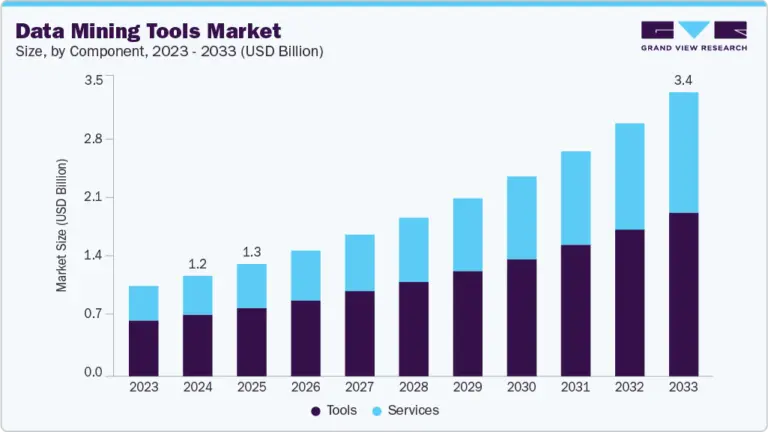
Source: grandviewresearch.com
The Essence of Data Mining: Unleashing Latent Value
At its core, data mining constitutes the computational practice of analysing extensive datasets to systematically identify patterns, correlations, anomalies, and other subtle insights. It utilises a formidable combination of statistical techniques, machine learning algorithms, and database technologies, establishing itself as a fundamental element within the broader paradigm of Knowledge Discovery in Databases (KDD). This comprehensive process governs the progression from the acquisition of raw data and meticulous preprocessing to the complex stages of interpretation and the application of the derived insights.
The strategic objectives of data mining are multifaceted, aiming to:
- Extract profoundly actionable insights to fortify executive and operational decision-making.
- Uncover veiled trends and profound interdependencies that defy superficial observation.
- Formulate robust predictions concerning future events, behaviors, and market dynamics.
- Detect aberrant patterns or outliers that signify potential threats or novel opportunities.
- Consolidate and visually render complex data structures into comprehensible narratives.
Furthermore, it is imperative to differentiate data mining from closely related disciplines. Whilst data analytics concentrates on statistical insights, data mining underscores the identification of patterns and the development of predictive models. Data warehousing facilitates storage and management, whereas machine learning predominantly drives numerous predictive endeavours. Data science encompasses the entirety of this process, from data acquisition to the communication of insights.
The Structured Journey: Data Mining Process Models
Data mining is far from a solitary act and is a meticulously organised and iterative endeavour that systematically converts inert data into dynamic knowledge. To assist practitioners in navigating this complex process, multiple standardised process models have been carefully devised. The most widely recognised and influential frameworks include KDD, CRISP-DM, and SEMMA.
- Knowledge Discovery in Databases (KDD) Process: This nine-stage, iterative model emphasises comprehensive domain understanding, meticulous data preparation including cleaning and transformation, judicious selection of algorithms, and thorough interpretation of patterns, ultimately leading to the deployment of the acquired knowledge.
- CRISP-DM (Cross-Industry Standard Process for Data Mining): A universally accepted six-phase framework that prioritises a strong understanding of business requirements, comprehensive data profiling, meticulous data preparation, iterative modelling, rigorous evaluation, and strategic deployment. Its industry-agnostic character renders it exceedingly versatile.
- SEMMA (Sample, Explore, Modify, Model, Assess): Developed by SAS, SEMMA concentrates on the technical aspects of data analysis, including the selection of representative data samples, exploratory visualisation, data transformation and feature engineering, model development, and comprehensive performance evaluation.
Unmasking Patterns: Key Data Mining Techniques
The arsenal of data mining techniques is expansive, with each method meticulously tailored to address specific analytical challenges and data modalities. A mastery of these techniques is paramount for unlocking meaningful insights.
Classification: Predicting the Future
Classification, a cornerstone of supervised learning, involves categorizing data instances into predefined classes based on their intrinsic features. Its utility spans from intercepting malicious emails to aiding in complex medical diagnoses.
- Algorithms: Decision Trees, Random Forests (ensemble methods), Support Vector Machines (SVM), k-Nearest Neighbors (k-NN), Naive Bayes, and the foundational elements of Neural Networks.
- Use Cases: Spam detection, disease prognosis, and credit risk assessment.
Clustering: Uncovering Natural Groups
Clustering, an unsupervised learning paradigm, groups data points such that members within a cluster share greater homogeneity than with those outside their cluster. This is invaluable for segmentation and discovery.
- Algorithms: K-Means, DBSCAN (density-based), Hierarchical Clustering.
- Use Cases: Customer segmentation, image analysis, and social network community detection.
Actionable Insights: Rules and Market-Basket Analysis
Association rule mining meticulously uncovers interdependent relationships between variables within large datasets, famously applied in market-basket analysis. It quantifies relationships using metrics like Support, Confidence, and crucially, Lift.
- Algorithms: Apriori, FP-Growth.
- Use Cases: Retail product placement optimization, strategic cross-selling.
Regression: Modeling Continuous Outcomes
Regression techniques are deployed to model the intricate relationships between a dependent variable and one or more independent variables, enabling the precise prediction of continuous outcomes.
- Algorithms: Linear Regression, Ridge and Lasso Regression (with regularization), Logistic Regression (for binary classification).
- Use Cases: Sales forecasting, financial risk quantification, predictive asset maintenance.
Anomaly Detection: Spotting the Unusual
Anomaly detection is instrumental in identifying data points that significantly diverge from anticipated norms, signaling potential fraud, errors, or emergent events.
- Techniques: Statistical models (Gaussian Mixture Models), Isolation Forests, Autoencoders, clustering-based methods.
- Use Cases: Fraud prevention, cybersecurity intrusion detection, and industrial fault identification.
Deep Learning: The New Frontier
Deep learning harnesses multi-layered neural networks to autonomously learn intricate hierarchical representations from raw data, revolutionizing fields previously thought intractable.
- Architectures: Convolutional Neural Networks (CNNs) for images, Recurrent Neural Networks (RNNs) for sequential data, Autoencoders for unsupervised learning, Generative Adversarial Networks (GANs).
- Use Cases: Advanced image recognition, natural language processing, and complex anomaly detection.
Specialized Mining: Text, Image, and Sequence
Beyond the core techniques, specialized mining extends to specific data types:
- Text Mining & NLP: Extracts insights from unstructured text using techniques like Topic Modeling (LDA) and Sentiment Analysis.
- Image & Multimedia Mining: Applies mining to visual data, utilizing feature extraction (e.g., SIFT, CNNs) for tasks such as object detection.
- Sequence & Time-Series Mining: Discovers patterns in ordered data, crucial for customer journey analysis or financial market forecasting.
Real-World Impact: Where Data Mining Thrives
The transformative power of data mining is evident across virtually every contemporary industry, fundamentally reshaping operational efficiencies and strategic decision-making.
- Marketing & Customer Analytics: From customer segmentation to churn prediction and market basket analysis, data mining crafts hyper-personalized strategies, optimizing customer retention and maximizing revenue.
- Finance & Banking: Anomaly detection systems meticulously flag fraudulent transactions, while regression and classification models perform precise credit scoring and comprehensive risk management.
- Healthcare & Life Sciences: Advanced models enhance disease diagnosis, profile patient risk for proactive interventions, and accelerate drug discovery by scrutinizing vast genomic and clinical trial data.
- Cybersecurity: Sophisticated anomaly detection and deep learning algorithms provide impenetrable shields against intrusions, while classification models adeptly filter spam and phishing attempts.
- Manufacturing & Supply Chain: Predictive maintenance forecasts equipment failures, process optimization refines production workflows, and demand forecasting meticulously calibrates logistics.
Conclusion
Data mining stands at the intersection of data abundance and strategic clarity. As explored throughout this study, it is far more than a technical mechanism for pattern extraction; rather, it is a disciplined, structured, and iterative pursuit that transforms inert information into measurable value. Through established process models such as KDD, CRISP-DM, and SEMMA, organisations systematically refine raw datasets into meaningful intelligence. Moreover, by leveraging techniques including classification, clustering, regression, association analysis, anomaly detection, and deep learning, enterprises uncover hidden relationships, predict future outcomes, and mitigate emerging risks. Across industries such as marketing, finance, healthcare, cybersecurity, and manufacturing, data mining consistently enhances operational precision and executive decision-making.
In an environment characterised by relentless digital expansion, the competitive advantage belongs to those who interpret complexity with foresight. Therefore, data mining emerges not merely as an analytical capability, but as a strategic imperative. Ultimately, organisations that invest in robust methodologies, ethical vigilance, and scalable infrastructures will be best positioned to convert expanding data landscapes into sustained innovation, resilience, and long-term growth.