


In 2026’s hyper-competitive digital economy, users judge a brand’s website in just 0.05 seconds, with 94% of first impressions driven by design and user experience. Web development has evolved beyond static pages into intelligent ecosystems powered by AI. From agentic workflows to infrastructural convergence, modern web engineering now centers on dynamic, adaptive, and data-driven digital experiences.
Agentic AI-First Development Era
AI-first development is now the industry baseline, moving beyond simple task automation to intelligent systems embedded across networks and devices. Developers increasingly act as architects, supervising autonomous agents that plan, execute, and monitor complex workflows independently.
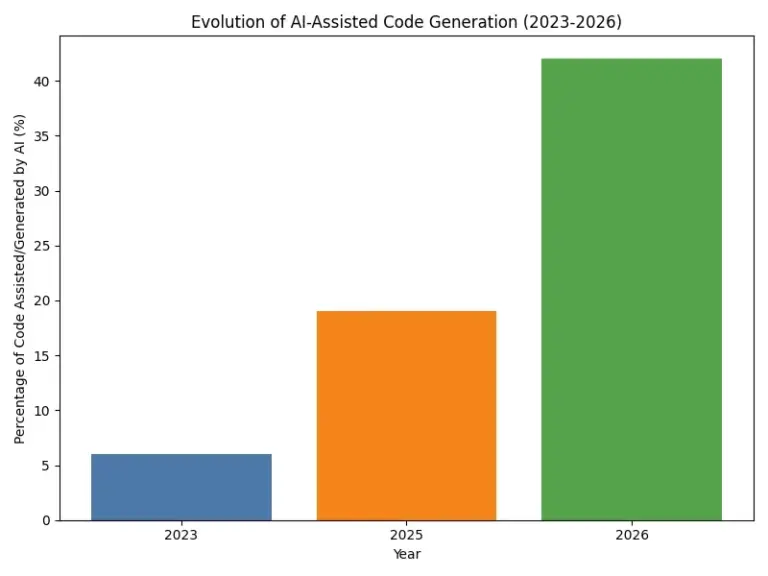
Adoption is widespread, with 90% of teams using AI daily. While 82% say AI speeds coding, trust remains low. Most developers question AI-generated code reliability, creating a verification bottleneck where senior engineers spend more time reviewing than building. Correction effort is often substantial, and many find reviewing AI output more cognitively demanding than reviewing human-written code.
Answer Engines and Predictive UX
AI now shapes both development and user experience. Over half of leaders prioritize
Answer Engine Optimization(AEO), ensuring structured content for AI-driven search. Predictive UX uses behavioral analytics and machine learning to anticipate user intent, dynamically adapting content in real time to deliver proactive, seamless, and highly personalized digital experiences.
Framework Convergence
The frontend landscape in 2026 is characterized by a singular, unifying technical trend the systemic removal of manual optimization through aggressive build-time compilation. The historical framework wars that once pitted React, Vue, Angular, and Svelte against each other have entered a period of profound synthesis. All major platforms have now embraced fine-grained reactivity and compiler-driven performance models, ushering in an era of unprecedented efficiency.
React 19.2 and the Stable Compiler Milestone
After its 2025 release, the React Compiler saw widespread adoption, replacing manual memoization like useMemo and React.memo. It automates performance optimization, reducing re-renders significantly. With stable React Server Components and useEffectEvent, server-first rendering now minimizes client-side JavaScript and improves architectural efficiency.
Angular's Renaissance and the Signals Paradigm
Angular 21 has transformed into a lightweight, zoneless framework powered by Signals as its default reactivity model. Removing zone.js reduced bundle size and improved load times, while standalone components and fine-grained updates deliver faster, more precise performance.
WebAssembly 3.0 and WebGPU Power
The browser has transformed into a highly sophisticated operating system, fully capable of running near-native applications. This profound evolution has been made possible by the finalization of the WebAssembly (Wasm) 3.0 specification in late 2025 and the ubiquitous support for WebGPU across all major browser engines.
WebAssembly 3.0 Garbage Collection
WebAssembly 3.0 marks a major milestone with native Garbage Collection, enabling languages like Java and Kotlin to run without heavy runtimes. Memory64 removes the 4GB limit, unlocking
up to 16GB for demanding browser-based applications like CAD, video editing, and 3D modeling.
WebGPU and Client-Side AI Inference
WebGPU unlocks local hardware for intensive AI inference, enabling enterprises to shift workloads to edge devices for lower cost and latency. Tools like Transformers.js run language and vision models directly in browsers, supporting privacy-preserving features such as local moderation and recommendations. This client-side shift strengthens privacy-by-design while balancing cloud and edge economics.
Spatial Web: Immersive Commerce UX
2026 represents the Android moment for extended reality (XR), where robust software ecosystems have finally harmonized with advanced hardware capabilities. WebXR has empowered businesses to seamlessly integrate 3D design into commerce, education, and entertainment, liberating users from the necessity of installing external applications.
E-Commerce Transformation and AR Try-On
WebXR has transformed e-commerce, with AR and 3D product views driving up to 94% higher conversion rates. Brands like IKEA and Wayfair enable true-to-scale furniture placement, while Sephora and Warby Parker offer virtual try-ons using smartphone cameras. These immersive experiences reduce uncertainty, boost purchase confidence, and cut return rates by over 20% in apparel and home goods categories.
The View Transition API and Native UX
On the traditional 2D web, the View Transition API has fundamentally revolutionized the perceived fluidity of web applications. Now widely supported in 2026, it empowers developers to create smooth, hardware-accelerated transitions between DOM states or full page navigations with minimal CSS and JavaScript. This powerful API obviates the need for heavy animation libraries, as the browser intelligently handles the “morphing” of elements by capturing snapshots of old and new views and animating between them directly on the GPU, delivering a truly native-like user experience.
Next-Gen Zero-Trust Cybersecurity
In 2026, web security has undergone a profound metamorphosis, transitioning from a reactive, human-dependent workflow to an autonomous, AI-driven defense ecosystem. The digital attack surface has expanded exponentially due to the proliferation of multi-cloud architectures, edge computing, and API-driven SaaS integrations, necessitating a more proactive and intelligent approach.
AI-Powered Threat Detection and Incident Response
Cybercriminals now use generative AI to automate reconnaissance and malware creation at scale. In response, organizations deploy AI-driven detection systems that analyze vast signals to spot anomalies and trigger autonomous responses. These self-healing security networks reduce costs by up to 70% while meeting stricter global cybersecurity reporting requirements.
The Zero-Trust and Identity-Centric Security Standard
Zero-Trust architecture is no longer an optional strategy; in 2026, it is the foundational model for modern web security. The core principle that no user or device is inherently trusted, irrespective of their location on the network is rigorously enforced through continuous session monitoring and real-time identity verification. Given that stolen credentials continue to account for 87% of data breaches, there has been a significant surge in biometric authentication and identity-centric security measures. To counteract the growing threat of deepfakes and synthetic identities, businesses are widely adopting multi-modal authentication and liveness detection as standard safeguards.
Conclusion
The web of 2026 is intelligent, adaptive, and AI-first. Agentic workflows, Answer Engine Optimization (AEO), predictive UX, WebAssembly 3.0, WebGPU, and WebXR are redefining how digital experiences are built and delivered. Development is now compiler-driven and performance-optimized by default, while client-side AI and immersive commerce elevate engagement. At the same time, autonomous cybersecurity and Zero-Trust architectures ensure resilience in an expanding threat landscape.
The defining currency of this era is the fusion of performance, intelligence, and trust. Organizations that embed AI-driven development, structured data ecosystems, high-performance computing, and identity-centric security into their core strategy will lead the digital economy. The future belongs to those who engineer for adaptability, scalability, and ethical innovation from the start.