


Beyond the Digital Ledger
For decades, Enterprise Resource Planning (ERP) systems have served as the digital backbone of commerce stoic, reliable systems of record meticulously cataloging the past. They were the definitive source of truth for financial reporting, inventory counts, and human resources data. However, in the dynamic and often volatile economic landscape of the mid-2020s, a system that only looks backward is a liability. The strategic imperative has shifted from reactive reporting to proactive execution. As we stand in early 2026, this shift is no longer a theoretical exercise it is the central pillar of competitive advantage.
The convergence of cloud computing, artificial intelligence (AI), and advanced automation is fundamentally transforming the ERP from a passive data repository into a sentient, active participant in business operations. This new breed of intelligent ERP functions as a system of action, capable of not just recording what happened, but understanding what is happening now and autonomously influencing what happens next. This evolution is fueling a market projected to surge dramatically, reflecting a profound change in how organizations perceive and leverage their core technology. The goal is no longer just efficiency; it is enterprise resilience and autonomy.
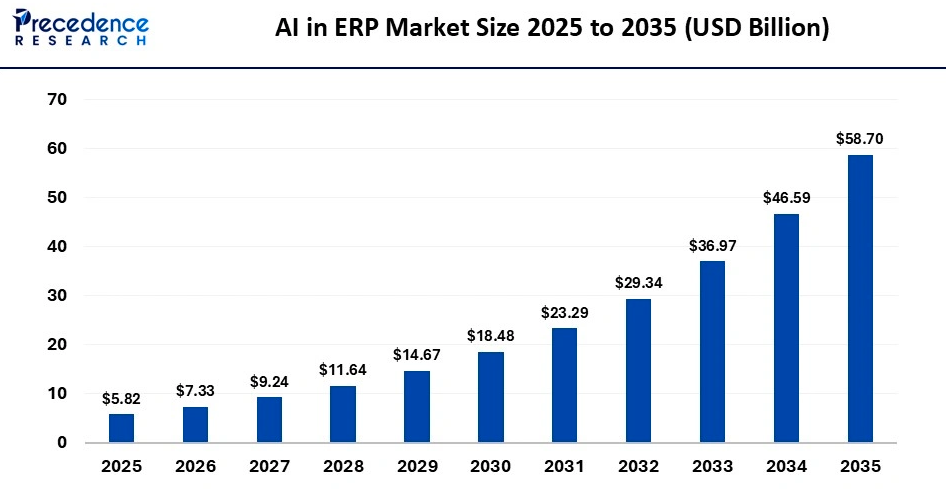
Source: precedenceresearch.com
The Architectural Metamorphosis: From Record to Action
The journey from a system of record to a system of action is predicated on a complete architectural modernization. Legacy, on-premise ERPs, with their siloed data and rigid structures, are ill-suited for the demands of real-time intelligence. The foundation of the modern autonomous enterprise is the Cloud ERP. Platforms like Oracle NetSuite, SAP S/4HANA Cloud, and Microsoft Dynamics 365 provide the clean, centralized, and accessible data that AI models require to function effectively. Without this unified data core, any AI initiative is built on sand.
However, a cloud foundation alone is insufficient. The true power emerges from the orchestration layer a sophisticated fabric of integrations that connects the ERP to the entire enterprise ecosystem. This layer, often powered by Integration Platform as a Service (iPaaS) and Event-Driven Architectures (EDA), acts as the enterprise’s central nervous system. Instead of waiting for nightly batch processes, an EDA propagates business events, such as a low-stock alert, a delayed shipment, or a large customer payment in real time across all connected applications. This allows AI agents to react instantly, creating a fluid and responsive operational model.
| Stage | System of Record (Past) | System of Intelligence (Present – 2026) | System of Autonomy (Future) |
|---|---|---|---|
| Core Function | Data centralization and historical reporting. | Real-time analysis, prediction, and decision support. | Autonomous workflow execution and self-optimization. |
| Data Focus | Structured, transactional data. | Structured and unstructured data, real-time events. | Continuous learning from internal and external data streams. |
| Key Technology | On-premise databases, batch processing. | Cloud ERP, Machine Learning, Generative AI, EDA. | Agentic AI, Digital Twins, Physical AI (Robotics). |
| Business Value | Process efficiency and auditability. | Decision velocity and operational resilience. | Business model reinvention and market leadership. |
The Dawn of Agentic AI: Your New Digital Coworker
The most transformative element in this new paradigm is the rise of Agentic AI. This represents a significant leap beyond traditional Robotic Process Automation (RPA), which excels at automating repetitive, rule-based tasks in the digital hands of an organization. Agentic AI, in contrast, automates cognitive work for the digital head. These agents are sophisticated software programs capable of multi-step reasoning, planning, and executing complex workflows with minimal human intervention.
Imagine an AI agent that detects a potential supply chain disruption by analyzing news feeds, weather patterns, and shipping lane data. It doesn’t just send an alert it autonomously evaluates alternative suppliers, checks their compliance and pricing within the ERP, and presents a fully vetted recommendation for a new purchase order to a human manager for final approval. In finance, an agent could manage the entire record-to-report process, continuously reconciling sub-ledgers throughout the month, flagging anomalies, and drafting variance explanations. This is not science fiction by 2026, leading ERP vendors are embedding these role-based agents directly into their platforms, creating a collaborative workforce of human and digital employees.
Unlocking Business Value Across the Enterprise
The tangible impact of this AI-ERP integration is being felt across every major business domain, moving beyond theoretical ROI to deliver measurable results.
Finance: The Pursuit of the Continuous Close
For Chief Financial Officers, the holy grail has long been the continuous close the ability to have an auditable, real-time view of the company’s financial position at any moment. AI is making this a reality. Intelligent agents automate the drudgery of intercompany reconciliations, journal entry validation, and accrual management. AI-powered analytics optimize working capital by predicting customer payment behaviors to shorten days sales outstanding (DSO) and modeling cash flow with unprecedented accuracy. This frees the finance team from the role of historical scorekeeper to that of strategic business partner.
Supply Chain: From Fragility to Resilience
The disruptions of the early 2020s exposed the fragility of global supply chains. Today, AI-integrated ERPs are building resilience directly into operations. Machine learning models analyze IoT sensor data from factory equipment to enable predictive maintenance, triggering work orders before a critical machine fails. Demand forecasting has evolved from simple historical analysis to complex models that incorporate real-time market signals, reducing both stockouts and costly excess inventory. The result is a supply chain that can not only withstand shocks but can also anticipate and adapt to them.
Human-Centered Autonomous Governance
Granting autonomy to software systems that control core business functions introduces new categories of risk and responsibility. Effective governance is not a barrier to innovation but a prerequisite for it. Organizations must establish robust frameworks to manage threats like data poisoning and adversarial attacks on AI models. The principle of Explainable AI (XAI) is paramount because business leaders and auditors must be able to understand the “why” behind an AI’s decision, especially in regulated industries.
Crucially, the narrative of AI in the enterprise must be one of amplification, not replacement. The most successful organizations are those that position AI as a copilot for their human workforce. By automating routine and repetitive work, AI liberates human talent to focus on tasks that require uniquely human skills, such as strategic thinking, complex problem-solving, creativity, and empathy. Realizing the full economic potential of AI requires significant investment not just in technology, but in change management and workforce reskilling, ensuring employees are equipped to thrive in this new collaborative environment.
Conclusion
The integration of AI and automation with Cloud ERP marks a pivotal moment in business technology. We are moving decisively from an era of passive data collection to one of active, intelligent, and autonomous operations. The sentient ERP is no longer a distant vision but an emerging reality, fundamentally reshaping how businesses create value, manage risk, and compete. Organizations that embrace this transformation by building a modern cloud foundation, leveraging the power of agentic AI, and fostering a culture of human-machine collaboration are not just optimizing their current processes. They are building the resilient, agile, and autonomous enterprise of the future and defining the new frontier of competitive advantage.