


The integration of Artificial Intelligence in the workplace is no longer a futuristic concept. It is a present-day reality fundamentally reshaping business operations, employee roles, and competitive landscapes. This technological wave is delivering transformative results, moving beyond simple automation to become a powerful partner in human endeavor. Empirical data reveals a monumental shift AI is not just improving efficiency, but unlocking unprecedented levels of productivity, enhancing work quality, and democratizing skills across the workforce. The evidence points to an average productivity increase of 66% across a range of professional tasks, a leap that would otherwise take decades of natural economic growth to achieve.
This article delves into the profound impact of AI on workplace efficiency, exploring the tangible benefits, the diverse applications, and the critical challenges that accompany this revolution. By understanding both the immense potential and the necessary precautions, organizations can strategically navigate this new era, fostering a future defined by a powerful and productive human-computer symbiosis.
The Unprecedented Surge in Productivity and Quality
The most compelling argument for AI adoption lies in its staggering impact on productivity. The numbers are not just incremental. They represent a paradigm shift in how work is accomplished.
Monumental Productivity Gains
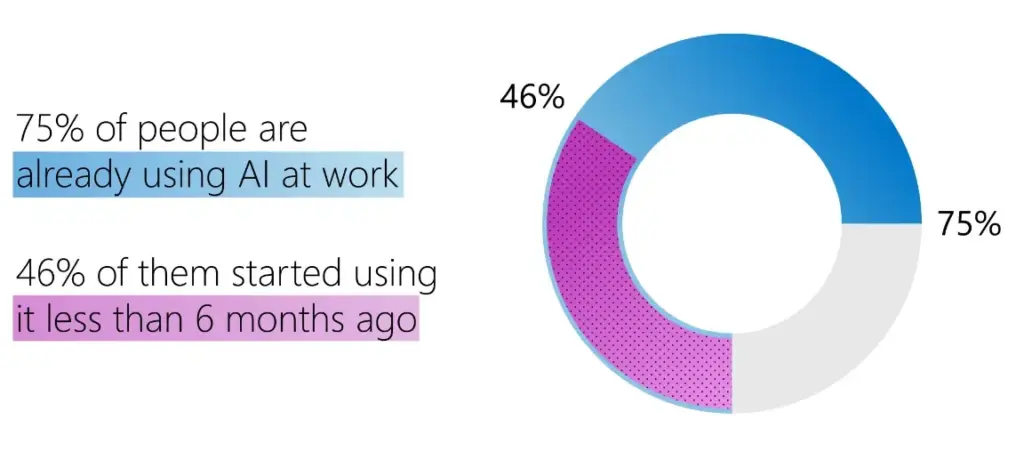
Across diverse fields such as customer service, business writing, and programming, generative AI tools have been shown to boost user throughput by an average of 66%. To put this in perspective, this single technological leap is equivalent to 47 years of natural productivity gains in the United States. The impact is even more pronounced in cognitively demanding fields.
[Source:www.microsoft.com]
Elevating the Standard of Work
More than just accelerating processes, AI enhances quality outcomes. This enhancement often stems from AI’s ability to rapidly generate a solid first draft, which liberates human professionals from the blank page. It allows them to redirect their cognitive energy toward the higher-value tasks of critical review, nuanced editing, and strategic polishing, ensuring the final product is not only completed faster but is also more refined and impactful.
Bridging Gaps and Empowering the Workforce
One of AI’s most profound and perhaps unexpected benefits is its role as a great equalizer, narrowing skill gaps and enhancing the overall employee experience.
AI as the Great Equalizer
Research reveals that AI disproportionately benefits less-skilled or less-experienced employees, effectively narrowing the performance gap between them and their top-performing colleagues. In a customer support environment, the lowest performing 20% of agents saw their productivity surge by 35% with AI assistance, while top performers saw only marginal gains. Furthermore, AI acts as a powerful learning accelerator. It was found that AI tools enabled new customer service agents to reach the productivity level of a seasoned professional in just two months, a process that typically takes eight months. This unfolds the acceleration in learning has massive implications for onboarding, training, and talent development.
Enhancing the Employee Experience
By automating mundane and repetitive duties like data entry, invoice processing, and scheduling, AI liberates employees to focus on more strategic, creative, and fulfilling work on increasing workplace efficiency. The shift energizes teams and drives innovation. AI also enhances the employee experience through personalization. AI-powered learning platforms can tailor training content to individual needs, while internal chatbots can provide instant, 24/7 support for HR and IT queries. The cumulative effect of streamlined workflows, reduced drudgery, and personalized support leads to higher employee satisfaction, greater engagement, and a healthier work-life balance.
From Data to Decisions: AI's Strategic Advantage
AI’s capability extends far beyond task execution; it is an invaluable tool for transforming raw data into actionable intelligence, fostering innovation, and optimizing operations across every department.
Diverse Applications Across the Enterprise
AI is being deployed in virtually every business function to drive strategic outcomes:
Customer Service: AI-powered chatbots and virtual assistants provide instant support, while sentiment analysis tools offer deep insights into customer satisfaction.
IT and Cybersecurity: AI automates routine network monitoring, detects security threats in real-time, and supports complex application modernization projects.
Human Resources: AI streamlines recruitment by screening resumes, personalizes onboarding, and analyzes performance data to identify development opportunities.
Sales & Marketing: Predictive analytics identify high-potential leads, personalize customer journeys, and optimize advertising campaigns for maximum ROI.
Operations & Manufacturing: Robotic Process Automation (RPA) handles repetitive tasks, while predictive maintenance algorithms reduce equipment downtime by up to 50% and associated costs by 25%.
Finance: AI systems detect fraudulent transactions, manage investment risks, and automate financial processes like expense tracking and reporting.
The Future of Artificial Intelligence in the Workplace
The future of work is not one of humans versus machines, but of humans and machines working in concert, where people and computers supplement each other in cooperative interaction, and this future has finally arrived. To realize the full benefits of this partnership, organizations must adopt a strategic and thoughtful approach to AI deployment.
The following best practices can serve as a roadmap for a successful and responsible AI integration:
Define Clear Business Objectives: Let your business strategy guide your AI strategy. Identify specific problems or opportunities where AI can deliver the most value, rather than adopting technology for its own sake.
Assess Current Capabilities: Conduct a thorough audit of your technological infrastructure, data quality and availability, and existing employee skill sets to identify your organization’s AI readiness.
Develop a Robust Data Strategy: Establish clear processes for data governance, security, and transparency. Create company-wide guidelines for the ethical use of data and AI.
Ensure Business Readiness: Bridge the gap between technical and business functions. Prioritize AI use cases by carefully balancing potential rewards with associated risks, and don’t hesitate to seek external expertise to fill skill gaps.
Start Small, Test, and Scale: Begin with pilot projects in low-risk, high-impact areas. Use these initial deployments to learn, refine your approach, and demonstrate value before scaling successful solutions across the organization.
Prioritize Employee Training and Upskilling: Invest in your people. Tailor training programs to equip employees with the skills they need to work effectively alongside AI and establish clear metrics to measure the success of these initiatives.
Conclusion
Artificial Intelligence presents an unprecedented opportunity to achieve remarkable gains in productivity, quality, and innovation while simultaneously creating more engaging and fulfilling work for employees. The evidence is compelling and clear: AI is a transformative force. However, unlocking its full potential requires more than just technological implementation. It demands a strategic, human-centric vision that proactively addresses the challenges of bias, ethics, and continuous learning. By fostering a true human-computer symbiosis and committing to responsible deployment, organizations can not only navigate the complexities of this new era but also lead the way in forging a future of unparalleled growth and competitive advantage.