


The Burnout Paradox: Elite Talent Drowning in Busywork
The stakes are high in the corporate world, and the Burnout Paradox is draining enterprise performance. Senior leaders are buried in administrative tasks instead of strategic work, wasting valuable cognitive capacity. This structural inefficiency weakens competitive advantage and delivers minimal return on high executive salaries.
Business Process Automation (BPA) reclaims that lost bandwidth. By eliminating manual processes and paper-based approvals, companies can shift from cost-cutting to orchestrating digital labor, decouple revenue growth from headcount and build a scalable, autonomous enterprise.
The Automation Hierarchy
As we move deeper into the decade, the divide between industry leaders and laggards is defined by how they perceive Digital Labor. The following truths challenge the traditional myths of automation and provide a roadmap for the high-impact deployment of intelligent systems.
Augmented Workforce
The great automation anxiety that characterized the early 2020s has largely been dispelled by the advent of collaborative digital ecosystems. Organisations with a forward-looking approach are utilising automation not to reduce human employment but to augment their existing workforce with perpetually available digital assets, which operate without the limitations imposed by cognitive fatigue.
While human employees remain bound to the traditional 9-to-5 work cycle, digital labour facilitates error-free operations on a continuous basis. This enables human teams to specialise in tasks that software cannot replicate, such as high-stakes negotiation, intricate problem-solving, and the development of deep client relationships. The focus has shifted from executing individual tasks to orchestrating overall outcomes.
Strategic Sequencing
Executive intuition frequently indicates that the most complex, high-friction bottlenecks should be automated initially to demonstrate value. However, this approach constitutes a strategic mistake. The most durable automation initiatives typically commence with high-volume, low-complexity tasks. By adopting a gradual approach, organisations establish a success template that secures stakeholder support and demonstrates immediate return on investment.
Effective pilot programs typically focus on four key domains:
Talent Advantage
Contrary to the prevailing sign that employees resist technological advancement, data indicates that 73% of IT directors have observed productivity improvements of up to 50% through the strategic implementation of automation. Eliminating monotonous and tedious tasks not only conserves time but also safeguards your organisation’s reputation. In the contemporary talent market, leading candidates perceive manual working environments as outdated. Automating routine activities communicates to your staff that their intellectual contributions are valued more highly than repetitive keystrokes.
From Static to Self-Directed
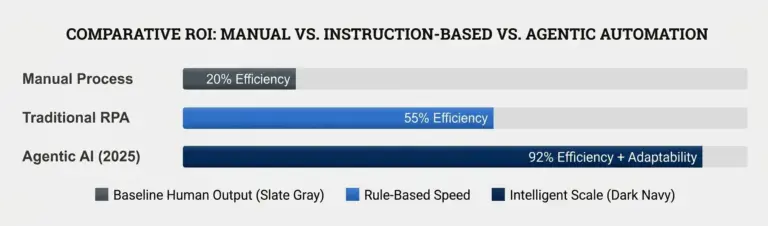
The traditional era of automation was characterised by instruction-based procedures, wherein software adhered to strict rules and ceased operation upon encountering an unforeseen variable. By the year 2026, we have transcended this frontier into the realm of Agentic Intelligence. These AI agents are intent-driven they comprehend the objectives, acquire knowledge from environmental data, and adapt to unpredictable circumstances autonomously, without requiring human intervention.
This evolution reflects a broader transformation in workplace design, where AI is no longer merely a productivity tool but a collaborative partner embedded within hybrid human-AI systems. For a deeper analysis of how agent-centric organisations are redefining productivity and value creation, explore our article on The Future of AI in Workplace Productivity.
| Feature | Traditional Automation (RPA) | Intelligent / Agentic Automation |
| Logic | Static, rule-based | Context-aware, learning logic |
| Decision Making | Predefined manual steps | Autonomous, goal-oriented |
| Flexibility | Breaks on anomalies | Self-correcting and adaptive |
| Scope | Task-specific silos | End-to-end multi-system workflows |
The agentic enterprise does not merely execute a predetermined script but also sustains operational momentum. Should a workflow encounter a missing data element, an intelligent agent analyses the context and autonomously retrieves the requisite information, thereby ensuring that human supervisors intervene solely in cases requiring exceptional creative or ethical judgment.
Achieving Industrialized Scale
The “80-20 Rule” constitutes an underlying constraint within contemporary commerce with a substantial proportion of a team’s efforts, up to 80% are frequently devoted to tasks that yield merely 20% of the overall results. Research conducted by McKinsey indicates that in 60% of all occupations, at least 30% of constituent activities can be automated.
By reclaiming that 30% of bandwidth, an organization achieves what we call Industrialized Scale. This is the capacity to handle 10x growth in volume without a 10x increase in administrative friction. This resource reallocation is a liquidity event for human capital freeing up the 80% of effort previously trapped in operational silos and funneling it directly into R&D and innovative market expansion.
By reclaiming 30% of bandwidth, an organisation attains what we refer to as Industrialised Scale. This represents the capability to manage 10x growth in volume without a 10x increase in administrative friction. Such resource reallocation constitutes a liquidity event for human capital, liberating 80% of effort previously confined within operational silos and redirecting it directly into Research & Development and innovative market expansion.
Rise of Autonomous Enterprises
As we look forward, the rise of “Autonomous Business Processes” will shape the competitive landscape. We are progressing towards a realm of Digital Labour, characterised by continuous digital assets that augment every employee. The goal is to build processes that autonomously pursue business objectives with minimal human oversight.
Platforms such as Salesforce’s Agentforce exemplify this paradigm shift. These agents function as always-on digital labor, capable of overseeing customer success and internal processes without the need for ongoing human intervention. It is anticipated that the business process automation market will attain a value of nearly $19.6 billion. The gap between “digital laggards” and “autonomous enterprises” will become insurmountable for organisations that do not incorporate adaptive, intent-based intelligence into their core operations at present.
Conclusion
The Burnout Paradox represents a structural constraint on organisational growth. Entities that persist in allocating elite talent to routine administrative tasks will find it increasingly challenging to remain competitive in a marketplace predominantly shaped by Digital Labour and Agentic Intelligence. Business Process Automation has become a strategic imperative that enhances cognitive capacity, bolsters the organisation’s reputation as an employer, and establishes the groundwork for Industrialised Scale. The evidence is undeniable: reclaiming even 30% of operational bandwidth can unleash exponential value without proportional increases in workforce.
The rise of Autonomous Business Processes marks a decisive inflection point. Enterprises that embed adaptive, intent-driven systems into their core operations will separate themselves from digital laggards permanently. The competitive advantage of the next decade will belong to organisations that orchestrate human ingenuity and intelligent automation into a unified, self-directed enterprise.