


The Quantum Leap in Marketing
The marketing landscape is currently experiencing an unprecedented transformation, propelled by the relentless advancement of artificial intelligence. By 2026, we are observing a comprehensive architectural overhaul, progressing beyond mere generative experimentation to encompass a sophisticated ecosystem supported by autonomous AI agents. This represents a revolution, redefining customer journeys, brand engagement, and the fundamental framework of marketing strategy. The future is now, characterised by its intelligent capabilities.
AI has cemented its position not merely as a tool, but as the foundational operating system of enterprise marketing. This era signifies the detachment of strategic objectives from tactical implementation, heralding what many refer to as the agentic web. Marketing is no longer confined to running discrete campaigns and is orchestrating sophisticated networks of specialized, autonomous AI agents that meticulously manage the customer lifecycle with a speed and precision previously unimaginable. The implications are profound, touching every facet of how brands connect with consumers.
The Agentic Marketing Workforce
AI models are rapidly becoming obsolete as specialized agents now collaborate seamlessly under centralized coordination, executing complex, end-to-end workflows. This new Digital Workforce of AI agents is independently handling tasks ranging from intricate lead qualification and deeply personalized outreach to comprehensive compliance validation and real-time budget reallocation.
The global agentic AI market is projected to reach an impressive US$8.5 billion in 2026, with ambitious forecasts suggesting a climb to US$35 billion by 2030, potentially soaring as high as US$45 billion if governance challenges are adeptly navigated. This surge is fueled by massive investment shifts, with up to 75% of companies expected to invest in agentic AI capabilities by the end of 2026, often replacing traditional Software-as-a-Service (SaaS) tools entirely.
Search Revolution: GEO, AEO, and Zero-Click Dominance
Search behavior in 2026 has undergone its most radical transformation since the dawn of the internet. Traditional search engines have metamorphosed into sense engines that prioritize deep context, intent, and semantic meaning over antiquated keyword density. This paradigm shift has necessitated the paramount rise of Generative Engine Optimization (GEO) and Answer Engine Optimization (AEO), as users increasingly seek direct, conversational answers rather than mere lists of links.
The Death of the Blue Link and the Rise of Zero-Click
Experts project a 25% decline in organic search traffic by 2026, a figure many still consider conservative given the rapid rise of AI Overviews. As AI-generated summaries increasingly dominate search queries, organic click-through rates can drop by as much as 61%. Yet the quality of remaining traffic is significantly higher. Users arriving via AI assistants tend to be far more qualified, converting at 4.4 times the rate of traditional search traffic. This shift signals not the death of search, but a fundamental transformation in how consumers discover and engage with brands online.
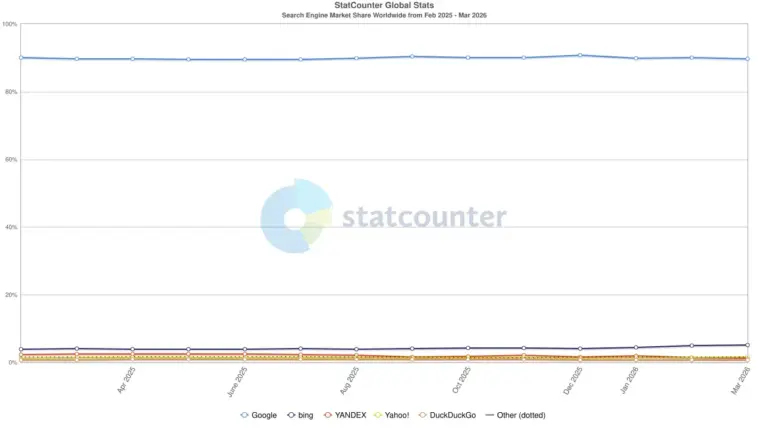
Source: statcounter.com
For marketers, the central challenge of 2026 is ensuring their brand is actively chosen by AI systems. This requires moving beyond conventional SEO toward a Search Everywhere Optimization (SEvO) strategy that builds visibility across AI platforms like ChatGPT, Gemini, and Perplexity as well as social channels such as Instagram and YouTube, and community forums like Reddit and Quora. AI systems increasingly favour content from trusted, authoritative sources, meaning brands must invest in building strong AI Authority and credibility metric shaped by podcast mentions, social presence, and reputable reviews. Brands that establish this authority now will be best positioned to earn prominent, positive references in AI-generated responses as the landscape continues to evolve.
Predictive Search and Intent Deepening
Search in 2026 is no longer a reactive exercise but a highly predictive discipline. Google’s sophisticated predictive engines now analyse comprehensive search histories, real-time contextual information such as location, device, activity, and even emotional tone to facilitate zero-query discovery. In this advanced model, artificial intelligence (AI) proactively provides results prior to a user’s explicit enquiry, curating feeds that adapt dynamically as the user’s intentions subtly change.
Hyper-Personalization and the Predictive Consumer Journey
Hyper-personalisation has progressed to an exceptional one-to-one level, rendering conventional broad-segmentation strategies entirely obsolete. The realm of marketing has shifted from discrete campaigns into Predictive Experience Design, wherein data-driven journeys adapt dynamically with each user interaction. This unparalleled level of precision is underpinned by the widespread collection of first-party and zero-party data, enabling brands to precisely customise content, pricing, and even brand tone in accordance with individual behaviours and transient micro-moments of intent.
This evolution closely mirrors the principles of adaptive branding, where brands continuously reshape their messaging, identity, and engagement strategies in response to real-time consumer signals. As explored in How AI-Powered Adaptive Branding Wins, organizations that integrate AI into their brand architecture can maintain consistency while dynamically adapting experiences across channels, devices, and customer contexts.
Real-Time Journey Orchestration
The seamless integration of AI into customer lifecycle management has enabled truly autonomous journey orchestration across all imaginable touchpoints. AI agents now process colossal data streams including intricate transaction logs and comprehensive support transcripts to calculate real-time churn risk and recommend precise next-best-action interventions. Diverging sharply from traditional rule-based automation, these agentic systems leverage probabilistic reasoning to determine, for instance, that a specific user has an 85% probability of converting if they receive a personalized offer within a specific 24-hour window.
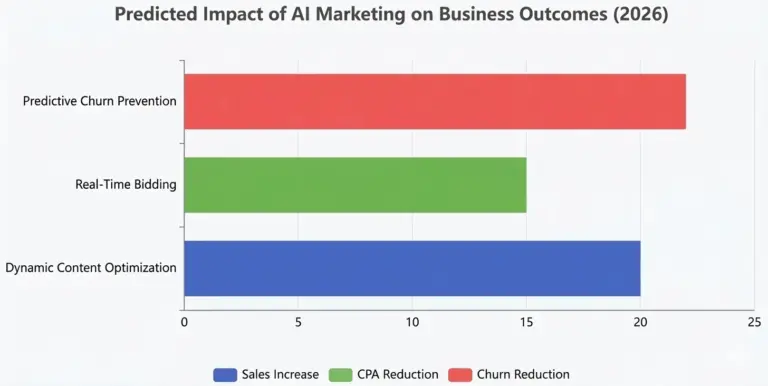
Dynamic Creative Optimization (DCO) enables this unusual level of personalization by using advanced machine learning to assemble thousands of customised ad variations in real time. By intelligently combining modular assets such as headlines, images, and calls-to-action (CTA) with diverse data signals such as location and past behavior, DCO transforms advertising from a broad one-to-many broadcast into a bespoke sequence of highly individualized conversations.
Indian Market: A Global Hotspot for AI-Led Commerce
India has indisputably emerged as one of the world’s fastest-growing markets for AI marketing adoption in 2026. This meteoric rise is propelled by a unique confluence of tech-savvy consumer behavior and a robust, supportive digital public infrastructure. The India AI Mission has significantly enhanced access to computing and datasets, cultivating a vibrant ecosystem where 89% of new startups reported AI integration as early as 2024.
Vernacular AI and the Democratization of Access
A defining characteristic of the Indian market is the explosive growth of vernacular AI content. Tier 2 and Tier 3 cities are experiencing a staggering 156% higher growth in Hindi, Telugu, and Tamil AI-generated content compared to English-only content in major metros. Voice search in local languages now accounts for an overwhelming 65% of queries, as regional players that leverage localized interfaces rapidly gain ground.
The adoption gap between metropolitan and tier 2 cities has remarkably shrunk to just 23% in 2026, down from 45% two years prior. This dramatic closure is a testament to affordable AI tools and comprehensive regional language support, which have democratized high-performance marketing capabilities. Indian consumers consistently demonstrate a higher level of trust in AI-driven recommendations than their global counterparts, often valuing GenAI for its perceived objectivity and personalized guidance throughout the purchase journey.
The Authenticity Barrier and AI Slop
As the sheer ease of content creation has inevitably led to an overload of AI-generated content or AI slop, the 2026 market has reached a critical tipping point where consumers actively, indeed voraciously, seek out human-centered storytelling. Leading brands such as Dove have responded by drawing clear, ethical boundaries around AI usage that pledge to unequivocally prohibit the use of AI to represent real women in advertising, strategically positioning ethics as a primary brand differentiator. Successful brands are intelligently deploying AI for backend support excelling at trend identification and subtitle generation while reverently keeping the human touch central to their narrative.
Organizational Transformation: The Professional Marketer
The sweeping shift to agentic and autonomous systems has fundamentally rewritten the job description of the marketing professional. The Successful SEO teams resemble product engineers more closely than traditional writers, with a concentrated emphasis on delivering tools rather than merely completing tasks.
From Execution to Orchestration
Modern marketers have transitioned from manual campaign management to pivotal roles as AI Orchestrators, Strategic Curators, and Vibe Directors. The ideal marketing professional of the future acts more like a visionary film director, adroitly coordinating with multiple AI tools to produce consistent, on-brand content at an unparalleled scale. AI literacy has become a primary hiring filter for teams that can effectively operationalize AI into repeatable processes compound their output, and accelerate progress exponentially, leaving manual teams to face unsustainable costs.
Conclusion
Artificial intelligence constitutes the framework influencing the manner in which brands will compete in 2026. From autonomous AI workforces and predictive search capabilities to highly personalised customer journeys and the expansion of vernacular languages in markets such as India, the field of marketing is transforming into a system of intelligent orchestration. Achieving success will require a careful balance between automation and credibility. Organisations that effectively integrate AI-driven strategies while maintaining human-centred storytelling will define the next era of marketing leadership.